A guide to LLMs' inner working
We as a beginner always wonder what happens when we ask questions to ChatGPT or Gemini and wonder how it gives us responses so fast and moreover so customized catering to our needs .
Well , it is not magic. It's a large language model, and once we understand a few core ideas, the whole process starts to make a lot of sense. Let's break it down step by step, starting from the very basics.
1. What is an LLM?
LLM is essentially a system that has "read" a very large amount of text and learned the patterns of how language works and bascally grammar, facts, reasoning styles, tone, and more.
Before LLMs, computers were terrible at anything involving open-ended human language. You could search for keywords, but you couldn't have a computer understand really a question and respond to it in natural language. LLMs changed all of that. They allow computers to read, summarize, translate, write, explain, and converse in a natural way
Some of the examples are ChatGPT,Claude,Gemini or Llama
2. What happens when we send a message to LLM?
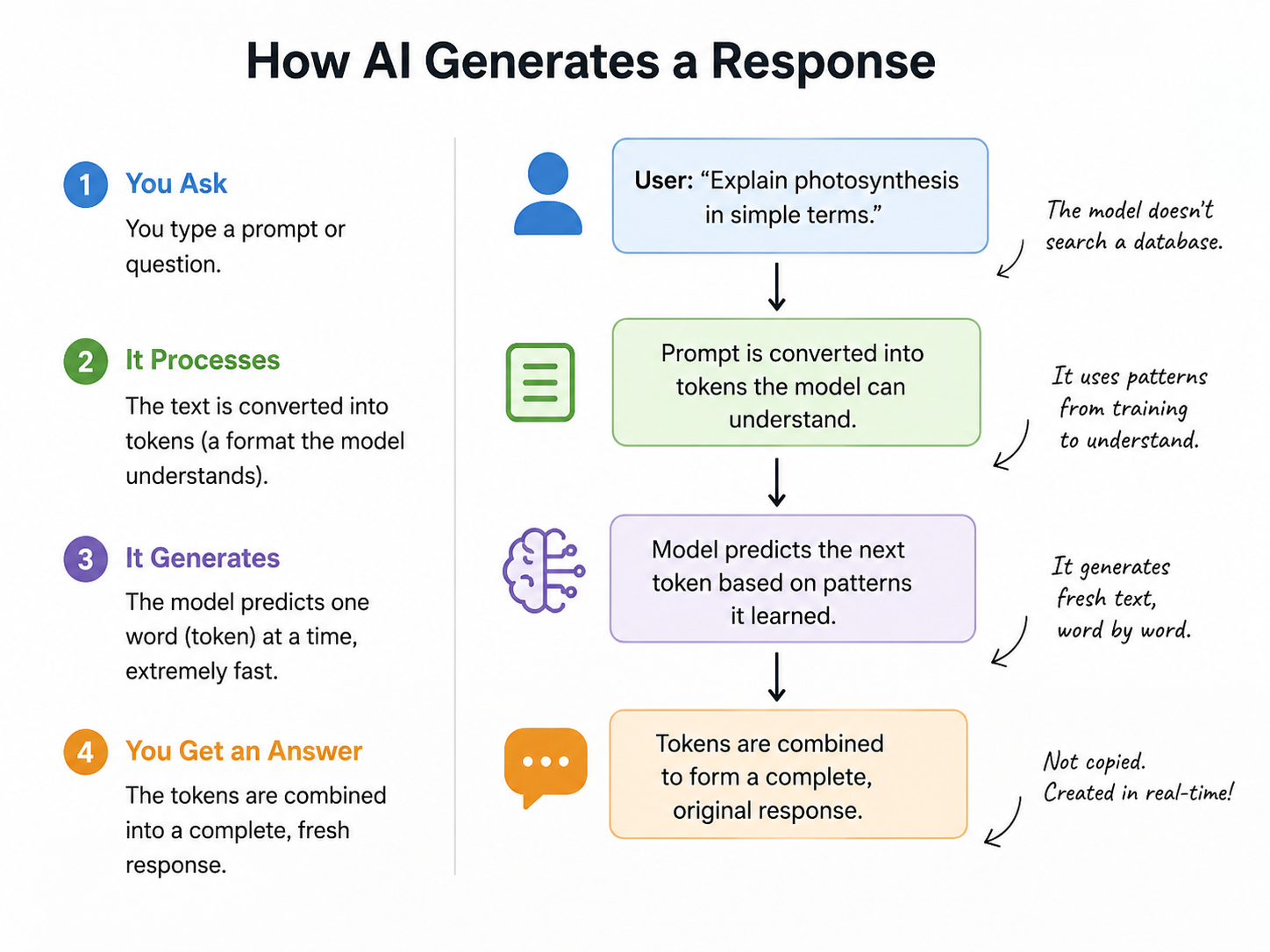
When we enter a prompt, the AI first converts our text into tokens, the small units it understands. Instead of searching for a stored answer, it predicts the most likely next token based on patterns learned during training. This prediction happens one token at a time, repeatedly, until a complete response is formed. The result is generated in real time, not copied from a database or webpage, making every response a newly created piece of text.
3. Why Computers Don't Understand Human Language
Computers understand only numbers, while human language is complex and full of meaning. Before an AI model can process text, it must convert words into numerical representations. This conversion creates the bridge between human language and machine understanding. That's why text is first broken into tokens, allowing the model to analyze and generate meaningful responses.
4. Tokenization: Breaking Language into Smaller Pieces
A token is a small piece of text, such as a word, part of a word, or even punctuation. Before AI can understand your prompt, it splits the text into these smaller units through a process called tokenization.
Instead of treating every word as a single unit, the model breaks unfamiliar or complex words into smaller, reusable pieces. For example, "reading" may become "read" and "ing." This helps the model understand new words it has never seen before.
Text → Tokens → Numbers → AI Processing
5. Transformers: The Technology Behind Modern AI
A Transformer is the neural network architecture that powers most modern Large Language Models (LLMs). In fact, the "T" in GPT stands for Transformer. Introduced by Google researchers in 2017, Transformers revolutionized AI by making it much better at understanding language.
Unlike older models that processed text one word at a time, Transformers use a technique called self-attention. This allows the model to consider every word in a sentence simultaneously and determine how they relate to one another. For example, in the sentence "The trophy didn't fit in the suitcase because it was too big," the model can correctly infer that "it" refers to the trophy, not the suitcase.
This ability to understand relationships across an entire sentence helps the model capture context more accurately, producing more natural and relevant responses. Because Transformers scale efficiently with more data and computing power, they have become the foundation of today's leading AI models.